
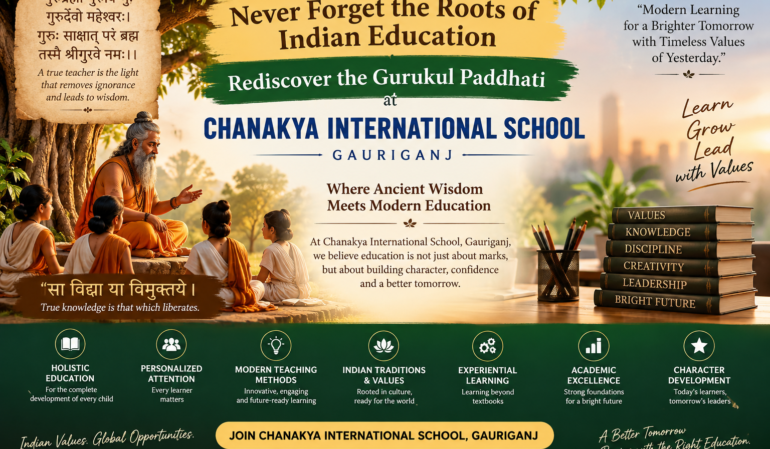
“विद्या ददाति विनयं, विनयाद् याति पात्रताम्।
पात्रत्वाद्धनमाप्नोति, धनाद्धर्मं ततः सुखम्॥”
Vidya gives humility; humility leads to worthiness, worthiness brings prosperity, prosperity enables righteous living, and from righteousness comes happiness.
Education has never been only about reading books, scoring marks, or passing examinations.
In the Indian tradition, education was a journey of life.
It was about learning how to think, how to behave, how to respect others, how to understand nature, how to develop discipline, and most importantly, how to become a better human being.
This timeless approach to learning is beautifully reflected in the ancient Gurukul Paddhati.
Today, when education is rapidly changing with technology, Artificial Intelligence, digital classrooms and new career opportunities, one question becomes increasingly important:
Can we prepare children for the future without making them forget their roots?
At Chanakya International School, Gauriganj, the answer lies in creating a meaningful connection between Indian values and modern education.
Because moving forward does not mean leaving our roots behind.
It means carrying the wisdom of our roots into the future.
What Was the Gurukul Paddhati?
The word Gurukul comes from two Sanskrit words—Guru and Kula, broadly referring to the teacher’s household or learning environment.
The traditional Gurukul system was not simply a place where students memorised information. It represented a learning environment in which the Guru and Shishya shared a close relationship based on guidance, discipline, respect and learning.
Students learned not only subjects but also values and life skills.
They were encouraged to understand:
- Discipline
- Respect
- Responsibility
- Self-control
- Humility
- Truthfulness
- Service
- Knowledge
- Practical skills
- Social responsibility
The purpose of education was therefore much broader than academic achievement.
It was about building character along with knowledge.
That idea remains remarkably relevant today.
The Real Meaning of Education in Indian Tradition
Indian educational thought has traditionally placed great importance on the development of the whole individual.
Knowledge was valuable, but knowledge without character was incomplete.
A child could be intelligent, but education also encouraged that child to become disciplined.
A student could be talented, but education also encouraged humility.
A learner could become successful, but education also emphasized responsibility towards family, society and the larger world.
This is why the ancient Sanskrit saying reminds us:
“सा विद्या या विमुक्तये।”
Sa Vidya Ya Vimuktaye.
True knowledge is that which liberates.
Knowledge should expand the mind.
It should help a child question, understand, discover and make responsible choices.
That is the deeper meaning of education.
Why Should We Remember the Gurukul Paddhati Today?
Modern children are growing up in a completely different world.
They have access to smartphones, artificial intelligence, digital learning platforms, online information and technologies that previous generations could not imagine.
Yet, despite all this technological progress, children still need the same fundamental human qualities:
Discipline.
Curiosity.
Empathy.
Respect.
Integrity.
Confidence.
Responsibility.
Technology can provide information.
But values teach children how to use that information wisely.
Artificial Intelligence can generate answers.
But education must teach children how to ask the right questions.
The internet can provide knowledge.
But teachers help children understand, evaluate and apply that knowledge.
This is where the wisdom of the Gurukul tradition continues to offer an important lesson.
Guru-Shishya: A Relationship Beyond the Classroom
One of the most meaningful aspects of the traditional Gurukul system was the relationship between the Guru and Shishya.
The Guru was not merely someone who delivered information.
The teacher was a guide, mentor and role model.
A great teacher does more than explain a chapter.
A great teacher can inspire a child to:
- Ask questions
- Think independently
- Discover strengths
- Learn from mistakes
- Respect others
- Develop confidence
- Keep learning throughout life
This principle remains essential in modern education.
Even in an age of smart classrooms and AI-powered learning, the human connection between teacher and student remains irreplaceable.
“गुरुर्ब्रह्मा गुरुर्विष्णुः…” — Respect for the Teacher
The traditional Indian understanding of the Guru is beautifully expressed in the famous verse:
“गुरुर्ब्रह्मा गुरुर्विष्णुः
गुरुर्देवो महेश्वरः।
गुरुः साक्षात् परं ब्रह्म
तस्मै श्रीगुरवे नमः॥”
The verse expresses deep reverence for the teacher as a source of knowledge and guidance.
For children, respecting teachers is not simply about following instructions.
It is about developing an attitude of learning, listening and openness.
A child who learns to respect knowledge becomes a lifelong learner.
From Gurukul to the Modern Classroom
Does embracing Indian educational roots mean going back to an old-fashioned education system?
No.
The real lesson is not to copy the past.
The lesson is to preserve timeless values while embracing useful progress.
A modern school can teach:
Mathematics + discipline
Science + curiosity
Technology + responsibility
Communication + humility
Leadership + empathy
Innovation + ethics
This is where the spirit of Gurukul education can complement modern schooling.
The goal is not ancient versus modern.
The goal is:
Ancient Wisdom + Modern Learning = Future-Ready Education
Chanakya International School, Gauriganj: Rooted in Values, Ready for the Future
At Chanakya International School, Gauriganj, the educational philosophy focuses on developing students academically as well as personally.
The school’s official philosophy emphasizes holistic education, strong values, personalized attention and modern teaching methods, with an educational environment designed to help students grow academically and personally.
This approach creates an important bridge between traditional Indian educational values and the needs of today’s children.
The idea is simple:
Give children knowledge, but also give them wisdom.
Give them technology, but also teach them responsibility.
Give them opportunities, but also teach them discipline.
Give them confidence, but also teach them humility.
That balance can help children grow into capable and responsible individuals.
Indian Values and Modern Technology Can Go Together
There was a time when people thought traditional values and modern technology belonged to completely different worlds.
Today, that distinction is becoming less meaningful.
A child can learn Sanskrit shlokas and explore Artificial Intelligence.
A student can understand Indian cultural traditions and learn modern scientific concepts.
A learner can practise yoga and also develop digital skills.
A child can respect traditional knowledge while becoming an innovative thinker.
This combination is not a contradiction.
It can be a strength.
The future belongs to children who can adapt to change without losing their identity.
Learning Beyond Textbooks
True education cannot be limited to textbooks.
Children learn through:
- Questions
- Conversations
- Experiments
- Projects
- Stories
- Sports
- Art
- Culture
- Teamwork
- Observation
- Real-life experiences
The Gurukul tradition reminds us that learning can happen through everyday experiences.
Modern experiential learning carries a similar idea forward: children understand concepts more deeply when they actively participate rather than simply memorise information.
At Chanakya International School, the focus on engaging and experiential learning supports the idea that children should be active participants in their education.
Character Building: The Heart of Meaningful Education
Marks can measure academic performance.
But they cannot completely measure:
- Kindness
- Honesty
- Courage
- Respect
- Empathy
- Responsibility
- Leadership
- Self-discipline
These qualities shape a child’s personality.
This is why value-based education matters.
A child who learns to say “thank you,” respect elders, help classmates, care for the environment and take responsibility for mistakes is learning something that cannot be found in a textbook alone.
Education should therefore answer two questions:
“What does my child know?”
and
“What kind of person is my child becoming?”
The second question is equally important.
The Importance of Discipline in a Child’s Life
One of the important lessons associated with traditional Indian education is discipline.
But discipline should not simply mean punishment or fear.
Healthy discipline means learning:
- When to study
- When to play
- How to manage time
- How to respect others
- How to complete responsibilities
- How to control distractions
- How to remain committed to a goal
In today’s world of constant notifications and digital distractions, these skills are more valuable than ever.
A disciplined child can learn to use technology without becoming controlled by it.
Education Should Develop the Mind, Body and Character
Indian educational traditions have long recognized that human development is multidimensional.
A child’s growth includes intellectual, physical, emotional, social and moral development.
That is why education should create opportunities for:
Intellectual Growth
Learning concepts, asking questions and developing critical thinking.
Physical Growth
Sports, exercise and healthy habits.
Emotional Growth
Understanding feelings, building confidence and developing resilience.
Social Growth
Working with others, communicating and respecting different perspectives.
Moral Growth
Understanding responsibility, honesty and ethical behaviour.
This is the essence of holistic education.
A Sanskrit Shlok Every Student Can Learn
One of the beautiful ways to connect children with Indian heritage is through Sanskrit wisdom.
For example:
“उद्यमेन हि सिद्ध्यन्ति कार्याणि न मनोरथैः।”
Udyamena Hi Siddhyanti Karyani Na Manorathaih.
Meaning:
Success comes through effort, not merely through wishes.
What a powerful lesson for a young learner.
Dreaming is important.
But dreams become achievements through:
Effort + Discipline + Patience + Perseverance.
This is exactly the kind of timeless wisdom that can complement modern academic learning.
Why Indian Culture Has a Place in Modern Education
Culture gives children a sense of identity.
When children understand their traditions, stories, languages, festivals and philosophical ideas, they gain a deeper connection with their heritage.
This does not mean closing the door to the wider world.
Instead, it can help children become confident global citizens who understand where they come from.
At Chanakya International School, cultural learning and Indian traditions can become meaningful parts of a broader educational journey, alongside modern subjects and future-oriented learning.
The school also highlights cultural engagement through school activities and celebrations, creating opportunities for students to connect learning with Indian traditions.
Why the Name “Chanakya” Carries a Powerful Educational Message
The name Chanakya immediately evokes the legacy of Acharya Chanakya, who is traditionally remembered as a scholar, teacher, strategist and thinker.
His legacy is strongly associated with knowledge, practical wisdom, discipline, strategy and leadership.
For a school, the name can serve as a reminder of an important educational principle:
Knowledge should create wisdom, and wisdom should create responsible action.
Today’s students will eventually become tomorrow’s:
- Doctors
- Engineers
- Scientists
- Entrepreneurs
- Teachers
- Researchers
- Administrators
- Artists
- Leaders
- Responsible citizens
Academic knowledge can prepare them for careers.
But values help prepare them for life.
What Parents Should Look for in a Modern School
Choosing a school is one of the most important decisions a parent makes.
Parents naturally consider academics, teachers, infrastructure and future opportunities.
But there are other questions worth asking:
Does the school encourage curiosity?
Does it help children become confident?
Does it develop communication skills?
Does it teach responsibility and discipline?
Does it provide opportunities beyond textbooks?
Does it balance modern education with values?
Does it understand that every child learns differently?
These questions shift the conversation from simply asking:
“Which school will give my child good marks?”
to a bigger question:
“Which learning environment will help my child become a capable, confident and responsible human being?”
The Future Needs Children Who Are Rooted and Ready
The world our children will enter will be different from the world we know today.
Artificial Intelligence will continue to evolve.
Technology will continue to transform careers.
Communication will become increasingly global.
New professions will emerge.
But some qualities will never become outdated.
Honesty.
Curiosity.
Discipline.
Empathy.
Courage.
Respect.
Integrity.
Learning.
These are timeless.
That is why the future of education should not be about choosing between tradition and technology.
It should be about bringing the best of both together.
**Rooted in values.
Guided by wisdom.
Powered by knowledge.
Ready for the future.**
Why Choose Chanakya International School, Gauriganj?
For parents looking for a school in Gauriganj that combines academic learning with holistic development, Chanakya International School presents an educational approach centered on the overall development of the child.
The school’s current educational messaging emphasizes:
- Holistic development
- Personalized learning
- Academic growth
- Indian traditions
- Modern teaching methods
- Experiential learning
- Creativity and curiosity
- Character development
- Future-oriented education
Its official website also describes facilities and learning initiatives connected with modern education, including AI and Robotics learning environments.
The larger vision is not simply to prepare students for the next examination.
It is to help prepare them for the next stage of life.
Frequently Asked Questions About Gurukul Education and Modern Schooling
What is the Gurukul Paddhati?
The Gurukul Paddhati was a traditional Indian approach to education in which students learned under the guidance of a Guru. Along with academic and intellectual learning, emphasis was placed on discipline, values, practical knowledge, responsibility and character development.
Why is the Gurukul Paddhati relevant today?
The modern world requires children to develop more than academic knowledge. Qualities such as discipline, respect, curiosity, responsibility, critical thinking and character remain important in every generation.
Can Gurukul values and modern education work together?
Yes. Traditional values such as discipline, respect, humility and responsibility can complement modern approaches such as technology-enabled learning, experiential education, scientific thinking and innovation.
Why are Indian values important in modern education?
Indian values can help children develop cultural awareness, responsibility, respect, ethical thinking and a sense of identity while they prepare to participate in an increasingly global world.
How does Chanakya International School, Gauriganj approach education?
The school’s stated approach focuses on holistic development, personalized attention, academic learning, Indian traditions, modern teaching methods and experiential learning.
What should parents look for when choosing a school?
Parents may consider academic quality, teaching practices, student support, learning environment, values, extracurricular opportunities, communication, safety and how well the school prepares children for both higher education and life beyond school.
Conclusion: Never Forget Your Roots
Education is a journey.
It begins with curiosity.
It grows through knowledge.
It becomes meaningful through experience.
And it becomes powerful when knowledge is guided by values.
The Gurukul Paddhati reminds us that education was never meant to be simply about collecting information.
It was about developing the mind, character and conduct of the learner.
Today, we have technologies our ancestors could never have imagined.
We have Artificial Intelligence, digital classrooms, advanced laboratories and access to information from around the world.
But as we move towards the future, we should not forget the wisdom that shaped generations before us.
Because a child who knows the latest technology is future-ready.
But a child who combines technology with wisdom, discipline, compassion and character is prepared for something even greater.
Never forget your roots.
Learn from the wisdom of the past.
Embrace the possibilities of the future.
Grow with values. Learn with purpose. Lead with wisdom.
Join Chanakya International School, Gauriganj
जहाँ शिक्षा केवल पढ़ाई नहीं, जीवन को समझने की यात्रा है।
Where education is not only about learning what to think, but also learning how to think, how to live and how to lead.
Chanakya International School, Gauriganj — rooted in Indian values, inspired by timeless wisdom, and preparing young minds for tomorrow.
Join Chanakya. Learn. Grow. Lead.