
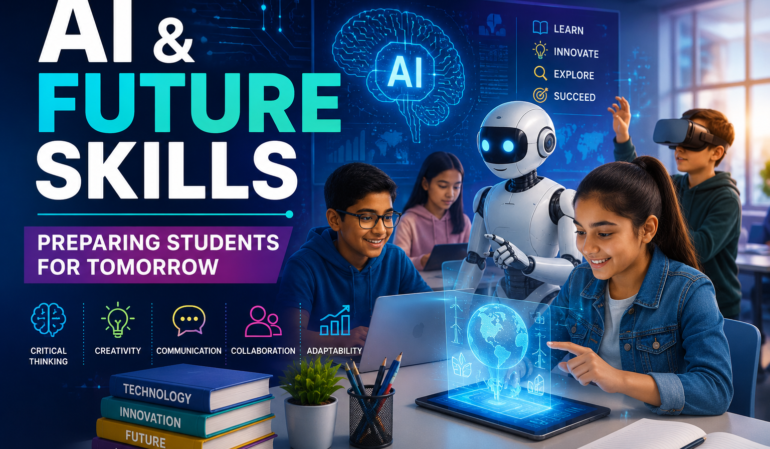
Why AI and Future Skills in School Education Are Essential for Every Student
Technology is evolving at an incredible pace, changing the way people learn, work, communicate, and solve problems. Just a decade ago, skills like Artificial Intelligence (AI), coding, data literacy, and digital collaboration were considered specialized knowledge. Today, they are becoming an important part of everyday life. Children growing up in this digital era will enter careers that require much more than academic excellence. They will need creativity, adaptability, emotional intelligence, critical thinking, and the confidence to work alongside advanced technologies.
This is why AI and Future Skills in School Education have become one of the most important discussions in modern education. Schools are no longer expected to prepare students only for examinations; they are expected to prepare them for life. The classrooms of today are shaping the innovators, entrepreneurs, scientists, engineers, doctors, artists, and leaders of tomorrow.
At Chanakya International School, we believe every child deserves an education that combines academic excellence with practical life skills. Our mission is to create confident learners who are ready to embrace opportunities, overcome challenges, and contribute positively to society. By encouraging curiosity, creativity, collaboration, and responsible use of technology, we help students become future-ready while staying grounded in strong moral values.
As education continues to evolve, parents are also looking for schools that can equip their children with skills that remain relevant for decades—not just until the next examination. This is where future-focused learning plays a vital role.
Table of Contents
- What Are AI and Future Skills in School Education?
- Why Education Must Change with the Times
- Understanding Artificial Intelligence in Simple Words
- Why Every Student Should Learn About AI
- Future Skills Every Child Should Develop
- How AI Is Transforming Classrooms
- The Importance of Critical Thinking
- Digital Literacy: A Life Skill for Every Student
- Preparing Students for Careers of the Future
- How Chanakya International School Builds Future-Ready Learners
- Frequently Asked Questions
- Conclusion
What Are AI and Future Skills in School Education?
Before understanding why these skills matter, it is important to know what they actually mean.
Artificial Intelligence, commonly known as AI, refers to computer systems that can perform tasks requiring human intelligence. These tasks may include recognizing speech, answering questions, understanding language, identifying images, analyzing information, or making recommendations.
Many students already interact with AI without realizing it. Voice assistants, navigation apps, online learning platforms, smart search engines, language translators, and personalized video recommendations all use Artificial Intelligence.
However, learning about AI in school is not about becoming a computer scientist overnight. Instead, it is about understanding how technology works, using it responsibly, and developing the skills needed to thrive in a digital world.
Future skills go beyond technology. They are the essential abilities that help students adapt to changing environments, solve problems creatively, communicate effectively, and continue learning throughout life.
These skills include:
- Critical Thinking
- Creativity
- Communication
- Collaboration
- Leadership
- Emotional Intelligence
- Adaptability
- Problem-Solving
- Digital Literacy
- Innovation
- Time Management
- Ethical Decision-Making
Together, AI and Future Skills in School Education prepare children not just for careers but for lifelong success.
Why Education Must Change with the Times
Education has always evolved alongside society.
Years ago, schools primarily focused on reading, writing, arithmetic, and memorization because those skills were enough to succeed in the workforce. As industries advanced, schools introduced science, mathematics, technology, and language learning to meet changing demands.
Today, another transformation is taking place.
Artificial Intelligence, automation, robotics, cloud computing, cybersecurity, renewable energy, biotechnology, and digital communication are becoming integral parts of everyday life. These advancements are reshaping industries at an unprecedented speed.
Many routine tasks are now automated. Businesses increasingly value employees who can think creatively, solve unfamiliar problems, communicate clearly, and collaborate with diverse teams.
This means education must also evolve.
Students should no longer be limited to memorizing facts. Instead, they should learn how to:
- Think independently
- Analyze situations logically
- Evaluate information critically
- Ask meaningful questions
- Develop innovative solutions
- Adapt to technological change
- Learn continuously throughout life
Schools that embrace this educational philosophy prepare students not only for academic achievement but also for long-term personal and professional success.
Understanding Artificial Intelligence in Simple Words
Artificial Intelligence may sound like a complex scientific concept, but its presence is already woven into everyday life.
Imagine asking your smartphone for directions, translating a language instantly, unlocking your phone with facial recognition, or receiving personalized recommendations while watching educational videos. These conveniences are powered by AI.
Artificial Intelligence works by analyzing large amounts of information, identifying patterns, and making intelligent predictions or suggestions.
For students, AI can become a valuable learning companion.
Instead of replacing teachers, AI supports education by:
- Personalizing learning experiences
- Helping students practice concepts independently
- Offering immediate feedback
- Making difficult subjects easier to understand
- Encouraging curiosity through interactive learning
- Supporting different learning styles
The role of teachers remains irreplaceable because education is much more than information. Teachers inspire, motivate, mentor, encourage, and nurture character—qualities no machine can truly replace.
The ideal classroom combines the strengths of technology with the wisdom, empathy, and experience of dedicated educators.
Why Every Student Should Learn About AI
Children today are growing up in an AI-powered world.
Whether they choose careers in medicine, engineering, law, agriculture, business, education, architecture, journalism, sports, or creative arts, Artificial Intelligence will likely become part of their professional lives.
Understanding AI gives students confidence rather than fear.
Instead of seeing technology as something mysterious, they begin to understand its possibilities and limitations.
Learning about AI helps students:
Develop Digital Confidence
Students become comfortable using technology responsibly while understanding how digital tools function.
Improve Problem-Solving Skills
AI-based activities encourage logical thinking and systematic approaches to solving challenges.
Encourage Innovation
Children become curious about creating solutions instead of simply consuming technology.
Prepare for Emerging Careers
Many future careers will require at least a basic understanding of Artificial Intelligence and digital technologies.
Become Responsible Digital Citizens
Students learn ethical technology use, privacy awareness, and responsible online behavior.
Understanding AI is no longer an advantage reserved for technology professionals—it is becoming an essential life skill.
Future Skills Every Child Should Develop
While Artificial Intelligence continues to advance, certain human abilities will become even more valuable.
These are the future skills every child should develop.
Critical Thinking
Critical thinking enables students to evaluate information, identify reliable sources, question assumptions, and make informed decisions.
Rather than accepting every answer they receive, students learn to ask:
- Is this information accurate?
- What evidence supports this idea?
- Are there alternative perspectives?
- What is the best solution?
These habits encourage lifelong learning.
Creativity
Machines can generate information, but genuine creativity comes from imagination.
Creative students become innovators who:
- Design new ideas
- Solve unique problems
- Express themselves confidently
- Build original projects
- Think beyond conventional solutions
Creativity fuels progress in every profession.
Communication Skills
Knowledge becomes meaningful only when students can communicate effectively.
Strong communication includes:
- Speaking confidently
- Listening actively
- Writing clearly
- Presenting ideas logically
- Working respectfully with others
These abilities help students succeed academically and professionally.
Collaboration
Modern workplaces depend on teamwork.
Schools should encourage students to:
- Share ideas
- Respect different opinions
- Solve problems together
- Learn from peers
- Build leadership through cooperation
Collaboration develops confidence and emotional maturity.
Adaptability
Technology changes rapidly.
Students who learn how to adapt remain confident regardless of changing circumstances.
Adaptability teaches children that learning never stops.
Instead of fearing change, they begin to embrace it.
Leadership
Leadership is not about giving instructions.
True leadership means:
- Taking responsibility
- Inspiring others
- Making ethical decisions
- Supporting team members
- Leading by example
Every child has leadership potential when given opportunities to develop confidence.
Emotional Intelligence
As technology becomes smarter, emotional intelligence becomes even more important.
Students should understand how to:
- Manage emotions
- Show empathy
- Build healthy relationships
- Resolve conflicts peacefully
- Respect diversity
These qualities strengthen character and create responsible citizens.
How AI Is Transforming Modern Classrooms
Traditional classrooms often focused on one-way teaching, where students listened while teachers explained concepts.
Today’s classrooms are becoming much more interactive.
Artificial Intelligence supports teachers by creating learning experiences that are:
- Personalized
- Interactive
- Engaging
- Data-driven
- Student-centered
Instead of simply memorizing information, students actively participate through discussions, activities, collaborative projects, and technology-enhanced learning.
This approach encourages deeper understanding rather than short-term memorization.
Modern education is no longer about remembering answers.
It is about learning how to discover them.
Learning Beyond Textbooks
One of the greatest advantages of AI and Future Skills in School Education is that learning extends beyond textbooks.
Students begin connecting classroom concepts with real-life situations.
For example:
- Mathematics develops logical reasoning.
- Science encourages curiosity and experimentation.
- Language strengthens communication.
- Social studies build awareness and empathy.
- Technology develops innovation.
When these subjects are combined with future skills, education becomes meaningful, engaging, and practical.
Instead of asking, “Why do I need to learn this?” students begin asking, “How can I use this knowledge to solve real problems?”
That shift in mindset is the true purpose of future-ready education.
The Importance of Digital Literacy in the 21st Century
As technology becomes an integral part of everyday life, digital literacy has become one of the most valuable skills a student can develop. Digital literacy is much more than knowing how to operate a computer or use a smartphone. It is about understanding how to access information, evaluate its credibility, communicate responsibly, protect personal data, and use technology ethically.
In today’s interconnected world, students spend a significant amount of time using digital devices for education, communication, and entertainment. Without proper guidance, they may struggle to identify reliable information or recognize online risks. Schools therefore have an important role in helping students become responsible digital citizens.
At Chanakya International School, students are encouraged to use technology as a tool for learning rather than simply for entertainment. They are guided to explore educational resources, improve research skills, and understand the importance of online safety and responsible digital behavior.
Digital literacy helps students:
- Conduct effective online research
- Identify trustworthy information sources
- Protect their digital identity
- Practice safe internet browsing
- Understand online privacy
- Communicate professionally in digital environments
- Use educational technology effectively
These abilities prepare students to navigate the digital world with confidence and responsibility.
Critical Thinking: The Most Valuable Skill in the AI Era
Artificial Intelligence can process information at incredible speed, but it cannot replace human reasoning, curiosity, empathy, or ethical judgment.
This is why critical thinking remains one of the most important future skills.
Critical thinking enables students to:
- Analyze situations carefully
- Compare multiple perspectives
- Ask meaningful questions
- Evaluate facts before accepting them
- Solve problems logically
- Make informed decisions
For example, when students search for information online, they often find thousands of results within seconds. Critical thinking helps them determine which sources are reliable, which information is accurate, and which opinions require further investigation.
Instead of memorizing answers, students learn how to think independently. This approach builds confidence and encourages lifelong learning.
Creativity and Innovation: Skills That Shape the Future
Innovation begins with imagination.
Some of the world’s greatest inventions started with simple questions:
- What if there was a better way?
- Can this problem be solved differently?
- How can we improve everyday life?
Creative thinking allows students to explore possibilities beyond traditional solutions. Whether they become engineers, doctors, artists, entrepreneurs, scientists, or educators, creativity helps them develop unique ideas and innovative solutions.
Schools that encourage project-based learning, creative activities, debates, presentations, and hands-on experiences help students develop imagination alongside academic knowledge.
At Chanakya International School, creativity is encouraged through classroom activities, cultural events, competitions, group discussions, art, sports, and experiential learning opportunities that allow students to discover their individual strengths.
Communication and Collaboration: Building Confident Individuals
Success in today’s world depends not only on what students know but also on how effectively they communicate their ideas.
Communication includes:
- Speaking confidently
- Listening actively
- Writing clearly
- Presenting ideas effectively
- Participating respectfully in discussions
Collaboration teaches students how to work together toward shared goals.
By participating in group activities and classroom projects, students learn:
- Teamwork
- Leadership
- Responsibility
- Respect for different opinions
- Conflict resolution
- Time management
These experiences prepare students for higher education and future workplaces where teamwork is essential.
Preparing Students for Careers That Don’t Yet Exist
One of the most exciting aspects of modern education is preparing students for opportunities that are still emerging.
The careers of tomorrow will require a combination of technical knowledge and human skills.
Future career fields include:
- Artificial Intelligence
- Robotics
- Data Science
- Machine Learning
- Cybersecurity
- Renewable Energy
- Biotechnology
- Environmental Science
- Space Research
- Digital Marketing
- Cloud Computing
- Financial Technology
- Healthcare Technology
While technology continues to evolve, employers consistently value individuals who can solve problems, communicate effectively, adapt quickly, and continue learning throughout their careers.
This is exactly why AI and Future Skills in School Education are becoming essential components of quality education.
How Chanakya International School Prepares Future-Ready Students
At Chanakya International School, education goes far beyond classroom instruction.
Our philosophy is centered on nurturing well-rounded individuals who are academically strong, emotionally intelligent, socially responsible, and prepared for future challenges.
We believe every child possesses unique talents and potential. Our responsibility is to provide an environment where those abilities can flourish.
Academic Excellence
Strong academic foundations remain the cornerstone of successful education. Our experienced teachers focus on conceptual understanding rather than rote memorization, helping students develop a genuine love for learning.
Activity-Based Learning
Children learn best when they actively participate in the learning process.
Interactive classroom activities encourage students to:
- Explore ideas
- Ask questions
- Conduct experiments
- Participate in discussions
- Apply concepts to real-life situations
This approach improves understanding and long-term retention.
Technology-Enabled Learning
Technology is integrated thoughtfully into the educational process to enhance student engagement and understanding.
Students learn how to use digital resources responsibly while developing confidence in modern learning environments.
Technology supports learning—it never replaces meaningful teacher-student interaction.
Leadership Development
Leadership opportunities help students become responsible, confident individuals.
Students are encouraged to participate in:
- School assemblies
- Cultural programs
- Sports activities
- Competitions
- Student leadership initiatives
- Community engagement programs
These experiences develop responsibility, confidence, and decision-making abilities.
Holistic Development
Education is not limited to academic achievement.
Holistic development includes:
- Physical fitness
- Mental well-being
- Emotional growth
- Social awareness
- Moral values
- Creative expression
Our balanced educational approach ensures that students develop into confident, compassionate, and capable individuals.
Value-Based Education
Technology may shape the future, but values shape character.
At Chanakya International School, students are encouraged to practice:
- Honesty
- Discipline
- Respect
- Kindness
- Integrity
- Responsibility
- Empathy
These principles help children become ethical leaders and responsible citizens.
The Role of Parents in Developing Future Skills
Parents play an equally important role in preparing children for the future.
Learning does not stop when students leave school.
Simple daily habits can significantly contribute to a child’s development.
Parents can encourage future-ready learning by:
- Reading together regularly
- Encouraging curiosity
- Allowing children to ask questions
- Supporting creative hobbies
- Limiting unnecessary screen time
- Promoting outdoor activities
- Discussing current events
- Appreciating effort rather than only results
When schools and families work together, children gain the confidence to explore, experiment, and grow.
Benefits of AI and Future Skills in School Education
Students who develop future skills experience advantages throughout their academic and professional journeys.
Some of the most significant benefits include:
- Greater confidence
- Improved academic performance
- Better communication abilities
- Enhanced creativity
- Stronger leadership qualities
- Effective teamwork
- Better decision-making
- Increased adaptability
- Strong problem-solving skills
- Higher career readiness
- Responsible digital citizenship
- Lifelong learning habits
These qualities help students succeed not only in examinations but also in life.
Why Parents Choose Chanakya International School
Choosing the right school is one of the most important decisions parents make.
Families trust Chanakya International School because of our commitment to excellence, innovation, and holistic education.
We offer:
- Student-centered learning
- Experienced and dedicated teachers
- Safe and nurturing learning environment
- Strong academic foundation
- Technology-integrated education
- Co-curricular development
- Leadership opportunities
- Value-based education
- Focus on future skills
- Individual attention for students
Our vision is to help every child become a confident learner, responsible citizen, and future leader.
The Future of Education Starts Today
The world will continue to change.
Technology will become more advanced.
New careers will emerge.
Industries will evolve.
The students who succeed in this future will not necessarily be those who memorize the most information. They will be the students who know how to think, learn, adapt, collaborate, innovate, and lead.
That is why schools must focus on developing future-ready learners today.
Education should inspire curiosity rather than fear.
It should encourage creativity instead of limiting imagination.
It should prepare students not only for examinations but for meaningful, successful, and fulfilling lives.
Why AI and Future Skills in School Education Matter More Than Ever
Artificial Intelligence is transforming industries across the globe, but the qualities that truly define successful individuals remain deeply human.
- Creativity
- Compassion
- Communication
- Integrity
- Critical Thinking
- Leadership
These qualities, combined with modern technology, create individuals who are capable of making a positive difference in society.
By embracing AI and Future Skills in School Education, schools empower students to face the future with confidence, resilience, and purpose.
Conclusion
Education has entered a new era where academic excellence alone is no longer enough. Students must also develop the skills required to thrive in an increasingly digital, interconnected, and innovation-driven world.
The integration of AI and Future Skills in School Education helps children become independent thinkers, responsible digital citizens, effective communicators, creative problem-solvers, and compassionate leaders.
At Chanakya International School, we are committed to providing an educational experience that balances modern learning with timeless values. Our goal is to prepare every student not only for higher education but also for the opportunities and challenges of tomorrow.
By nurturing curiosity, encouraging innovation, and building strong character, we empower students to achieve excellence in every aspect of life.
The future belongs to learners who never stop growing—and that journey begins with the right education.
Frequently Asked Questions (FAQs)
1. What are AI and Future Skills in School Education?
AI and Future Skills in School Education refer to the combination of technological awareness, digital literacy, critical thinking, creativity, communication, collaboration, leadership, and adaptability that prepares students for future careers and lifelong learning.
2. Why is Artificial Intelligence important for students?
Artificial Intelligence helps students understand modern technology, improve problem-solving skills, enhance digital literacy, and prepare for careers that increasingly involve AI-powered tools and innovation.
3. What are the most important future skills every student should learn?
The most valuable future skills include critical thinking, creativity, communication, collaboration, leadership, adaptability, emotional intelligence, digital literacy, problem-solving, and ethical decision-making.
4. How does digital literacy help students?
Digital literacy enables students to use technology responsibly, conduct reliable research, protect their online privacy, communicate effectively, and become responsible digital citizens.
5. How can parents support future-ready education?
Parents can encourage reading, creativity, curiosity, problem-solving, healthy technology habits, and open discussions that help children develop confidence and lifelong learning skills.
6. Why should schools teach AI and future skills?
Schools play a vital role in preparing students for an evolving world by combining academic learning with practical skills that improve career readiness, innovation, and personal development.
7. How does Chanakya International School prepare students for the future?
Chanakya International School provides a balanced education that combines academic excellence, activity-based learning, technology-enabled education, leadership development, value-based learning, and holistic growth to help students become confident and future-ready individuals.
Ready to Shape Your Child’s Bright Future?
Every child deserves an education that inspires curiosity, builds confidence, and prepares them for tomorrow’s opportunities.
At Chanakya International School, we are committed to nurturing young minds through academic excellence, innovation, character development, and future-focused learning.
Admissions are now open. Join us in empowering the next generation of thinkers, innovators, leaders, and lifelong learners.
Visit: https://cisgauriganj.org/
Together, let’s build a brighter future—one student at a time.