
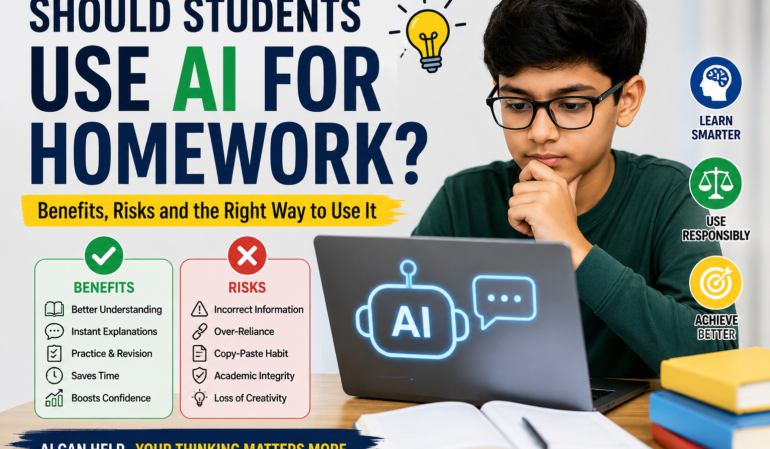
Artificial intelligence has quickly become part of everyday life, and education is no exception. Today, students can use AI tools to ask questions, understand difficult topics, practise lessons, improve writing, generate examples and receive explanations within seconds.
But this convenience also raises an important question for students, parents and teachers:
Should students use AI for homework?
The answer is not simply yes or no.
AI can be a valuable learning assistant when students use it to understand concepts, practise skills and improve their work. However, using AI to complete an entire assignment, copying answers without understanding them or submitting AI-generated work as one’s own can undermine the very purpose of homework.
The most useful way to think about AI is this:
AI should help students learn—not replace the learning process.
For school students, the goal should not be to find the fastest way to finish homework. The goal should be to understand the subject, develop problem-solving skills, build confidence and become an independent learner.
This article explains the benefits and risks of using AI for homework and provides practical guidance on how students can use artificial intelligence responsibly.
Should Students Use AI for Homework?
Yes, students can use AI for homework when it is permitted and when the technology is being used to support genuine learning.
For example, a student who does not understand a mathematics concept could ask an AI tool to explain the concept in simpler language. A student learning English could use AI to identify grammar mistakes and then correct them independently. A science student could ask for practice questions after studying a chapter.
These are examples of using AI as a learning assistant.
The situation becomes very different when a student simply enters an assignment question, copies the response and submits it without understanding the answer.
There is an important difference between:
“Help me understand this.”
and
“Do my homework for me.”
The first approach can encourage learning. The second can prevent it.
Students should therefore use AI thoughtfully, follow their school’s or teacher’s instructions and remain responsible for their own learning.
Why Are Students Using AI for Homework?
There are several reasons AI has become attractive to students.
AI Provides Quick Explanations
Students sometimes struggle with textbook explanations or may not understand something after hearing it once in class.
An AI tool can provide another explanation using simpler words or a different example.
For instance, instead of repeatedly reading a difficult science definition, a student might ask:
“Explain this concept as if I am a Class 8 student and give me two simple examples.”
This can make a difficult idea easier to understand.
AI Can Help Students Practise
Learning does not stop after reading a chapter.
Students need opportunities to practise what they have learned. AI can help generate practice questions, quizzes, vocabulary exercises and revision activities.
For example, after studying a history chapter, a student could ask for ten practice questions and attempt them without looking at the answers.
AI Can Support Students When They Are Stuck
Sometimes a student knows the basics but does not know how to begin a difficult problem.
Instead of asking AI for the final answer, the student can ask for a hint or the first step.
This encourages the student to continue solving the problem independently.
AI Can Help With Revision
Students can use AI to turn their own notes into revision questions, identify concepts they need to review or practise explaining a topic.
Used correctly, this can make revision more interactive.
AI Can Support Writing Skills
AI can help students identify grammar, spelling or sentence-structure problems.
However, students should understand the corrections rather than simply accepting every suggested change.
Writing is a skill that improves through practice. If AI writes everything for the student, the student loses valuable opportunities to develop that skill.
Benefits of Using AI for Homework
When used responsibly, AI can provide several benefits for students.
1. AI Can Explain Difficult Concepts
One of the most useful applications of AI in education is explanation.
Students learn at different speeds. A concept that is easy for one student may be difficult for another.
AI can provide alternative explanations using:
- Simpler language
- Real-life examples
- Step-by-step explanations
- Analogies
- Practice questions
- Different approaches to the same problem
For example, a student struggling with fractions might ask:
“Explain fractions using a pizza example.”
The purpose is not to get the answer to a homework question. The purpose is to understand the underlying concept.
Once the student understands the concept, they can solve the assigned problem independently.
2. AI Can Provide Step-by-Step Learning Support
Many students become frustrated when they see a difficult question and do not know where to start.
AI can help students break a large problem into smaller steps.
For example, instead of asking:
“What is the answer?”
a student can ask:
“What information do I need to identify first?”
Then:
“What formula or concept should I consider?”
And finally:
“Can you check my method?”
This type of interaction encourages students to think through the problem.
3. AI Can Help Students Practise
Practice is one of the strongest ways to reinforce learning.
Students can ask AI to create:
- Multiple-choice questions
- Short-answer questions
- Revision quizzes
- Vocabulary exercises
- Mathematics problems
- Science questions
- Grammar exercises
- Interview-style questions
The student can attempt the questions first and then use AI to review the answers.
This turns AI from an answer generator into a practice partner.
4. AI Can Help Students Identify Mistakes
Students often make mistakes without realizing why they happened.
AI can be useful for reviewing a student’s reasoning.
For example, a student might write:
“I solved the problem this way. Can you tell me where my reasoning went wrong without solving the entire question for me?”
This approach encourages the student to examine the mistake.
However, students should remember that AI can also make mistakes. If an AI explanation seems confusing or contradicts a textbook or teacher, the student should ask the teacher and verify the information.
5. AI Can Make Learning More Interactive
Traditional studying often involves reading, writing and memorizing.
AI can make learning more conversational.
Students can ask follow-up questions such as:
- Why does this happen?
- Can you explain it another way?
- Can you give me an example?
- What is the difference between these two concepts?
- Can you give me a practice question?
- Can you test me on this chapter?
This type of questioning can encourage curiosity.
6. AI Can Help Students Become More Independent Learners
A strong student is not someone who never needs help.
A strong learner knows how to find help, ask good questions, evaluate information and continue learning independently.
AI can become one of several learning resources available to students.
Books, teachers, classmates, experiments, educational websites, school resources and AI tools can all contribute to learning.
The important thing is that students remain actively involved.
What Are the Risks of Using AI for Homework?
AI can be useful, but students also need to understand its limitations.
Using AI without boundaries can create problems that affect both academic performance and long-term learning.
1. Students May Stop Thinking for Themselves
The biggest risk is dependence.
If a student uses AI every time a question becomes difficult, they may gradually become less comfortable with struggling through a problem.
But productive struggle is part of learning.
Students need opportunities to:
- Think
- Make mistakes
- Try different solutions
- Ask questions
- Change their approach
- Discover answers
If AI removes all of these steps, the student may finish homework faster but learn less.
2. AI Can Give Incorrect Information
AI-generated answers can sound confident even when they are inaccurate.
This is particularly important when students are researching facts, historical events, scientific information, quotations, statistics or other important details.
Students should never assume:
“AI said it, so it must be true.”
Instead, they should develop the habit of checking important information using reliable educational resources, textbooks, class materials or their teachers.
Learning to question information is an important skill in the digital age.
3. Copying AI Answers Can Damage Learning
Imagine a student receives a perfect-looking answer to a difficult question.
They copy it into their notebook and receive a good grade.
But later, when the same concept appears in an examination, the student cannot solve it.
The homework was completed, but the learning did not happen.
This is why students should focus on understanding rather than simply producing a finished answer.
4. AI Use Can Create Academic Integrity Problems
Whether AI use is acceptable depends on the assignment and the rules established by the teacher or school.
Some activities may allow AI for brainstorming or practice. Others may require completely independent work.
Students should always follow the instructions provided for a particular assignment.
Submitting AI-generated work as personal work when that is not allowed can create academic integrity concerns.
The safest approach is simple:
When in doubt, ask the teacher.
5. AI Can Reduce Creativity When Used Incorrectly
Creativity grows when students generate their own ideas.
If students always ask AI to provide the topic, introduction, arguments, examples and conclusion, they may miss the opportunity to develop their own voice.
AI can help brainstorm possibilities, but students should still think, select, question and create.
6. Students Need to Protect Their Privacy
Students should be careful about the information they enter into AI tools.
They should avoid unnecessarily sharing:
- Passwords
- Personal contact information
- Private family details
- Sensitive school information
- Other people’s personal information
- Confidential documents
Students should learn that responsible technology use includes protecting personal information.
The Right Way for Students to Use AI for Homework
The most important question is not:
“Can students use AI?”
It is:
“How should students use AI?”
A simple six-step approach can help.
Step 1: Try the Homework Yourself First
Before opening an AI tool, read the question carefully.
Review your textbook and class notes.
Think about what you already know.
Try solving the problem yourself.
Even if your first attempt is incorrect, it gives you something to learn from.
Step 2: Ask AI for Help, Not Just the Answer
This is one of the most important changes students can make.
Instead of asking:
“Solve this question for me.”
try:
“Explain how I should approach this problem. Give me a hint but do not provide the final answer.”
This keeps the student involved.
Step 3: Ask Follow-Up Questions
Do not stop after receiving one explanation.
If something is unclear, ask:
“Can you explain that in simpler language?”
Or:
“Can you give me another example?”
Or:
“Why does this step work?”
Good questions can make AI much more useful as a learning tool.
Step 4: Verify Important Information
AI should not be the only source of truth.
Compare important information with your textbook, classroom notes and trusted educational resources.
If something seems incorrect, ask your teacher.
The ability to verify information is just as important as the ability to find it.
Step 5: Write and Solve the Final Work Yourself
If an assignment requires independent work, students should produce their own response.
AI can help students understand the material, but the final learning should belong to the student.
A useful test is:
Could I explain this answer to my teacher without opening the AI tool?
If not, the student may need to study the concept again.
Step 6: Review What You Learned
After finishing homework, take a moment to ask:
- What did I learn?
- What was difficult?
- What mistake did I make?
- Can I solve a similar problem?
- Can I explain the concept in my own words?
This turns homework into a learning experience rather than simply a task to complete.
Good vs Bad Ways to Use AI for Homework
Understanding the difference between responsible and irresponsible AI use can make the process much easier.
| Better Use of AI | Poor Use of AI |
|---|---|
| Asking for an explanation | Copying the complete answer |
| Asking for a hint | Asking AI to do the entire assignment |
| Creating practice questions | Submitting AI work as your own |
| Checking grammar and learning from corrections | Letting AI write everything |
| Brainstorming ideas | Using AI instead of thinking |
| Reviewing your reasoning | Assuming every AI response is correct |
| Creating a revision quiz | Avoiding textbooks and teacher guidance |
| Asking follow-up questions | Using AI where the assignment prohibits it |
The goal is not to eliminate technology from education.
The goal is to make technology work for learning rather than against it.
How Students Can Use AI for Different Subjects
AI can support different subjects in different ways.
AI for Mathematics
Students can use AI to:
- Understand mathematical concepts
- Request hints
- Check their working
- Practise similar problems
- Review mistakes
- Learn different solution methods
A good mathematics prompt might be:
“I attempted this problem. Please identify the first step where my method went wrong and explain why.”
This is much more educational than simply requesting the final answer.
AI for Science
Science students can use AI to:
- Understand difficult concepts
- Generate revision questions
- Explain scientific terminology
- Compare concepts
- Create practice quizzes
- Explore real-world examples
However, students should verify scientific information, especially when conducting research or preparing important assignments.
AI for English
Students can use AI to:
- Check grammar
- Understand vocabulary
- Practise sentence construction
- Brainstorm possible ideas
- Receive feedback on clarity
- Practise reading and writing
But students should maintain their own writing voice.
AI should help students become better writers—not replace their writing practice.
AI for History and Social Science
Students can use AI to:
- Create revision questions
- Understand historical concepts
- Organize topics for revision
- Compare different ideas
- Build study guides
Because historical information can be complex, students should verify important facts using reliable educational materials.
AI for Computer Science
AI can be particularly useful for understanding programming concepts.
Students can ask AI to:
- Explain code
- Identify possible errors
- Explain programming terminology
- Provide practice exercises
- Break down a program line by line
Again, students should understand the code rather than simply copy it.
How Parents Can Guide Children in Using AI
Parents do not necessarily need to completely ban AI tools to encourage responsible use.
Instead, parents can help children understand how to use technology wisely.
Talk About AI Instead of Only Saying “Don’t Use It”
Children are more likely to make responsible decisions when they understand why certain behaviours are risky.
Parents can discuss questions such as:
- How does AI help you?
- What happens when AI gives an incorrect answer?
- How do you check information?
- When should you ask your teacher?
- What information should never be shared?
These conversations can help children develop digital judgment.
Ask Children to Explain Their Work
One simple question can reveal whether genuine learning has taken place:
“Can you explain this answer to me?”
If the child can explain the concept confidently, the AI may have been used as a useful learning support.
If the child cannot explain the answer, it may be time to revisit the topic.
Encourage Verification
Parents can encourage children to compare AI responses with textbooks, school notes and teacher explanations.
The lesson is simple:
Technology can provide information, but students must learn how to evaluate it.
Set Clear Family Rules
Families can create reasonable expectations around AI use.
For example:
- Try the homework independently first.
- Do not copy complete answers.
- Never share sensitive personal information.
- Follow teacher instructions.
- Use AI for learning rather than avoiding work.
- Ask for help when something does not make sense.
What Should Teachers and Schools Teach Students About AI?
AI literacy is becoming an important part of preparing students for a technology-driven world.
Students need more than the ability to open an AI tool and type a question.
They need to understand:
- How AI tools can help
- Where AI can fail
- How to ask useful questions
- How to evaluate AI-generated information
- How to protect personal information
- How to use AI ethically
- When human judgment is necessary
- How to maintain academic integrity
Schools can help students develop these skills alongside traditional academic abilities.
The objective should not simply be to ask:
“How can we stop students from using AI?”
A more productive question is:
“How can we teach students to use AI responsibly, critically and creatively?”
That approach prepares students not only for today’s classroom but also for a future in which AI is likely to be part of many professions.
AI Should Support Teachers, Not Replace Them
Artificial intelligence can provide explanations, generate practice activities and assist with certain learning tasks.
But education is much more than information delivery.
Teachers understand their students.
They observe classroom behaviour, recognize confusion, encourage effort, provide emotional support and adapt teaching based on the needs of individual learners.
A teacher can notice when a student is discouraged.
A teacher can encourage a student after failure.
A teacher can connect a lesson to the student’s interests and experiences.
AI cannot replace the human relationship at the heart of education.
The strongest model is therefore not AI versus teachers.
It is teachers, students and technology working together responsibly.
A Simple AI Homework Checklist for Students
Before using AI, ask:
Did I try the question myself?
While using AI, ask:
Am I using AI to understand rather than simply copy?
Am I checking whether the response makes sense?
Before submitting homework, ask:
Do I understand this answer?
Did I follow my teacher’s instructions about AI?
Can I explain my work in my own words?
After completing the homework, ask:
Could I solve a similar question without AI?
If the answer is yes, AI may have supported genuine learning.
If the answer is no, go back to the lesson and continue learning.
Frequently Asked Questions About AI and Homework
Is it okay for students to use AI for homework?
Students can use AI for homework when the teacher or school permits it and when the tool is used to support learning. Students should avoid copying answers and should follow the rules for each assignment.
Is using ChatGPT for homework cheating?
Not necessarily. It depends on how it is used and what the assignment rules allow. Using an AI tool to understand a concept or practise questions can be different from submitting AI-generated work as your own when independent work is required.
Can AI help students learn better?
Yes, when used appropriately. AI can provide explanations, practice questions, examples and feedback. However, students still need to think, practise, verify information and complete their own learning activities.
What are the disadvantages of AI for students?
Potential disadvantages include overdependence, inaccurate information, reduced independent thinking, weaker writing or problem-solving practice, privacy concerns and academic integrity issues.
How should students use AI responsibly?
Students should first attempt their work, ask AI for explanations or hints, verify important information, follow school rules, protect personal information and make sure they understand the final answer.
Should students use AI to write essays?
AI can potentially help students brainstorm ideas, understand a topic or review grammar when such use is permitted. Students should not automatically submit AI-generated essays as their own work. They should develop their own ideas, writing skills and understanding.
Can AI give wrong answers to homework questions?
Yes. AI can produce incorrect or misleading information. Students should critically evaluate AI responses and verify important information using reliable educational resources and teacher guidance.
How can parents monitor AI use for homework?
Parents can talk openly with children about responsible AI use, ask them to explain their homework, encourage fact-checking and establish clear family expectations around privacy, academic honesty and independent learning.
Will AI replace teachers in schools?
AI can support teaching and learning, but teachers provide human guidance, mentorship, judgment, encouragement and relationships that technology cannot fully replace. AI is better viewed as a tool that can complement education rather than replace teachers.
The Future of AI and School Education
The future of education is unlikely to be about choosing between traditional learning and technology.
Instead, students will need to learn how to combine knowledge, critical thinking, creativity, communication and technology.
Artificial intelligence may become increasingly useful for personalized practice, research, revision and learning support. At the same time, students will need stronger skills for evaluating information and recognizing when technology is wrong.
This makes critical thinking more important, not less.
A student who knows how to question an AI response, verify information, identify weaknesses and develop an independent solution will be better prepared than a student who simply knows how to generate an answer.
The future-ready student is therefore not the student who uses AI the most.
It is the student who knows when to use it, how to use it and when to think independently without it.
How Chankya International School, Gauriganj Can Help Students Prepare for the Future
At Chankya International School, Gauriganj, education is about helping students grow academically while developing character, confidence and strong values.
The school emphasizes a nurturing learning environment, personalized attention, academic excellence, Indian values and modern teaching approaches.
In a changing educational environment, these principles are especially important.
Technology can give students access to more information than ever before. But information alone does not create a well-educated student.
Students also need:
- Curiosity
- Discipline
- Critical thinking
- Creativity
- Communication skills
- Problem-solving abilities
- Strong values
- Respect for teachers and others
- Responsible use of technology
AI can become one part of this learning journey when students are taught to use it thoughtfully.
For parents, the important question is not simply whether a school uses modern technology.
It is whether students are learning how to use technology responsibly while maintaining strong academic foundations and human values.
A balanced education prepares children for both the opportunities and challenges of the future.
Parents interested in learning more about Chankya International School, Gauriganj, its educational approach and admissions-related information can visit the school’s official website or contact the school directly.
Conclusion: Use AI as a Learning Partner, Not a Homework Shortcut
So, should students use AI for homework?
Yes—but responsibly.
Artificial intelligence can be a valuable learning partner when students use it to understand difficult concepts, practise skills, ask questions, review their work and explore new ideas.
But AI should never become a substitute for thinking.
Students should still attempt problems, read their textbooks, listen to teachers, make mistakes, practise, ask questions and develop their own ideas.
The most important distinction is simple:
Use AI to learn, not to avoid learning.
A student who copies an AI answer may finish homework quickly.
A student who uses AI to understand the answer can develop a skill that lasts much longer.
The real goal of education is not simply to complete today’s homework. It is to prepare students to think independently, solve problems, communicate effectively and make responsible decisions throughout their lives.
As artificial intelligence continues to influence education and society, these abilities will become even more valuable.
AI can provide an answer.
But students must learn how to ask the right questions, evaluate the answer and think for themselves.
That is the kind of learning that prepares students for the future.